Custom Search

Forex News Update

Live Forex News and Analysis Review Update


Subscribe to this Feed by Email Subscribe to this Feed by Email

Subscribe to this Feed by Email Subscribe to this Feed by Email

Subscribe to this Feed by Email Subscribe to this Feed by Email
Subscribe to InstaForex Company News by Email
Showing posts with label Federal. Show all posts

November 26, 2011

How The Federal Budget Will Finally Get Fixed

The congressional supercommittee officially becomes a failure today, but while it could not come up with $1.2 trillion in budget savings, it did show us that there are exactly two ways in which Washington's red ink can finally be stopped.

The first is what I would call Reaganesque realignment. If the 2012 elections provide a decisive edge to one party or another, that party will have a chance to impose the policies it favors to try to bring government spending back into some sort of sensible relationship to revenue.

The second is the European method - the dynamic that is playing out right now in Spain, Italy, Greece and other spendthrift eurozone nations. If we do not get our act together, bond buyers will eventually stop fooling themselves into thinking that our government's debt is virtually risk-free, just as they have stopped believing that European sovereign debt is safe. The cost of further borrowing - as well as the cost of servicing earlier debts - will become prohibitive. At that point our political system will come up with a solution, like it or not, because there will be no other choice.

The supercommittee was destined to fail for the reasons I discussed four weeks ago. It was designed to try to do something that simply cannot be done right now: convince the two political parties to willingly compromise on their core political objectives and policy beliefs. A lot of people are castigating lawmakers for their intractability, but it is probably unfair, or at least unrealistic, to expect them to behave otherwise.

Most House members come from districts dominated by their own party. Deviating from party orthodoxy does not earn respect; it earns a primary challenge from your party's hardliners. Most senators, likewise, come from states that are decidedly red or blue. Only a few have a chance to run in the middle - and they can only appeal to that middle after they first satisfy their party's base in the primaries. The system is designed to drive moderates out of elections before they even have a chance to run. That does not make compromise easy.

Beyond electoral politics, it is not Congress' fault that Americans are divided fairly evenly into two camps regarding how they think their government should operate. It is even less Congress' fault that Americans are not particularly rational or consistent. A lot of people who support Republicans say the government should spend much less money, including on entitlements, but they don't want changes in their Social Security or Medicare benefits. A lot of Democrats want more jobs but less robust corporations. You can't get from Point A to Point B, but these same voters blame politicians for failing to reconcile their own irreconcilable demands.

Neither Republican nor Democratic politicians will buck their party's true believers, partly because they can't and partly because they are true believers themselves. They really think the approaches they espouse are the right ones, and that the other side's policies would bring the United States, or at least a large portion of its citizenry, to rack and ruin.

So the only way to get a solution is to have one imposed, either by voters or outsiders. If enough voters become convinced of the wisdom of, say, raising taxes or cutting spending, politicians who generally oppose that approach will eventually be forced to respond. If financial markets stop sustaining our current policies, our policies will change because there will be no other choice.

The big question is how much damage we will do as we pile up debt at around $100 billion every month while we wait to get things under control. There is a chance it will be considerable. That's unfortunate, but like the supercommittee's failure to reach a compromise, it is absolutely predictable.

Either we wait for the markets to save us from ourselves, or we save ourselves first. Next year's elections will tell us which it is going to be.

For more articles, please visit the Palisades Hudson Financial Group LLC newsletter or subscribe to the blog.

Newsletter: http://palisadeshudson.com/sentinel/

Blog: http://palisadeshudson.com/current-commentary/


View article source


November 17, 2011

Super Committee Looking for Places to Cut the Federal Budget - Census on the Chopping Block

It is truly amazing how much money was spent on the census in the US in 2010. In fact, I was quite bothered by the results, because the data was obviously skewed and incorrect. As a businessperson I follow all the statistics from the federal government, because I know it helps me make decisions.

Even though I am retired now from the franchising industry, I often consult small businesses and startups and therefore I need access to that information. Quite frankly if the government can't do a better job, at a better price, collecting this information, then maybe they shouldn't do it at all. Okay so let's talk about this for a second shall we.

Currently, corporations in America have far more data than the US government when it comes to the demographics of the US. Not only that, but by the time they go through your social networking page, and all the other data available, they know more about you than a burglar might learn burglarizing your home and going through all your personal files. Seriously, and we all know that's true, so let's not kid ourselves.

Recently, on Halloween 2011 there was a rather spooky article in the Wall Street Journal. The article was titled; "U.S. Census Confronts Budget Ax," by Ben Casselman. The article stated;

"Washington politicians often battle over what economic statistics mean and what to do about them. Now, they are fighting about the statistics themselves. The House Appropriations Committee didn't explicitly cut the 2012 economic senses; the panel cut President Barack Obama's proposal of a $1 billion census budget to only 855 million."

Now then, there's an obvious solution to this problem, and there is a way to get better data and better results, and more statistically reliable reporting by merely hiring the US post office which is also in debt to do the census for the government. After all the US postal workers already go to every house, and they pretty much have a good idea who lives there. Secondly, no one hates their postal person, and chances are the citizens won't lie to them when filling out the form.

Not only that people can fill out the form and leave it in their mailbox and the post office can pick it up, or folks can just drop it in the mail. That solves two birds with one stone and helps the U.S. Postal Service with their incredible budget problems. Why is it that people in Washington can figure this out? It's such a simple fix. Please consider all this and think on it.

Lance Winslow has launched a new provocative series of eBooks on Future Concepts. Lance Winslow is a retired Founder of a Nationwide Franchise Chain, and now runs the Online Think Tank; http://www.worldthinktank.net/


View article source


December 27, 2010

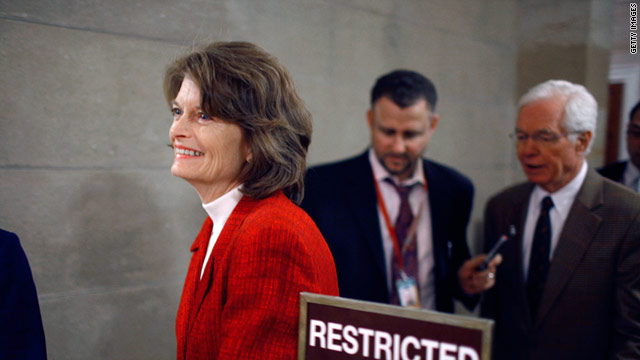
Miller won't contest Murkowski certification; pursues federal suit - CNN International

Murkowski won as a write-in candidate after losing GOP primaryMiller argues that Alaska law does not allow the counting of misspelled names on write-in ballotsMurkowski holds a 2,200-vote lead even when challenged votes are discountedMiller had until Monday to file an appeal
(CNN) -- Republican Senate candidate Joe Miller said late Sunday he is dropping his opposition to incumbent Lisa Murkowski being certified as winner in the Alaska Senate race, but will continue with a federal lawsuit.
"After careful consideration and seeking the counsel of people whose opinion I respect and trust, I have decided that the federal case must go forward. The integrity of the election is vital and ultimately the rule of law must be our standard," Miller said in a statement. "Nevertheless, I have also decided to withdraw our opposition to the certification of the election, ensuring that Alaska will have its full delegation seated when the 112th Congress convenes next month."
Last week, the Alaska Supreme Court ruled against Miller in his appeal, denying his claim that state law was not followed on counting write-in votes.
In the ruling, the Alaska Supreme Court affirmed the decision of the superior court, saying, "There are no remaining issues raised by Miller that prevent this election from being certified." At the time, a spokesman for Miller's campaign said they were "disappointed" with the decision.
"We are disappointed the Alaska Supreme Court has ignored the plain text of Alaska law and allowed the Division of Elections to effectively amend the state election code without even giving the public an opportunity for notice and comment," Miller spokesman Randy DeSoto said in a statement Wednesday.
The Alaska Division of Elections had already said that the state would move forward to ask the judge to lift the injunction on certifying the election unless the Miller campaign filed an appeal by Monday -- which it will now not do.
The Murkowski campaign anticipated further appeals by Miller.
"We ... anticipate that Joe (Miller) will continue to pursue his baseless claims in federal court until his money runs out," Murkowski spokesman Kevin Sweeney said in a statement last week.
After the election in November, Miller filed a challenge against the Division of Elections to ensure the state law, which calls for write-in votes to match the name of the candidate, was followed. He has argued that Alaska law does not allow the counting of misspelled names on write-in ballots.
However, the Division of Elections set guidelines before counting began that allowed for a voter's intent to be considered when determining whether to count a ballot for a write-in candidate.
Murkowski launched a write-in bid following her loss to Miller, a Tea Party favorite, in the state's August 24 Republican primary.
In the original superior court decisions, a judge ruled that Miller did not provide proof of election official fraud, or that "there would be a sufficient change to the election results if these claims were true."
The Associated Press called the race for Murkowski last month when she had a 10,328-vote lead over Miller, a figure that includes the 8,159 ballots contested by Miller observers. Not including those ballots, she has a 2,169-vote lead.
CNN's Steve Brusk contributed to this report


November 9, 2010

Governor Christie's US Attorney Expenses Questioned in Federal Report - Bloomberg


New Jersey Governor Chris Christie Excerpt Sept. 21 Sept. 21 (Bloomberg) -- New Jersey Governor Chris Christie talks about his efforts to lower taxes and overhaul the state's public-employee pension system, the future of the Republican party and the Tea Party movement, and Christie's political future. Christie speaks with Margaret Brennan on Bloomberg Television's "InBusiness." (This is an excerpt of the full interview. Source: Bloomberg)

New Jersey Governor Chris Christie, while serving as U.S. attorney, billed taxpayers for hotel costs that exceeded the federal government’s lodging rates by as much as $242 a night, according to a report by the Justice Department’s inspector general.

The report highlights travel spending by five unidentified prosecutors among 208 who served as U.S. attorneys during 2007- 2009. One, identified as U.S. Attorney C, was Christie, his spokesman, Michael Drewniak, acknowledged. He said Christie explained the expenses when they were questioned during the 2009 campaign.

Attorney C exceeded the government room rate on 15 of 23 vouchers submitted during the years studied, spending a total of $2,176 more than the prescribed rate, the report said.

“The U.S. attorney provided insufficient, inaccurate, or no justification for 14 of 23 trips (61 percent) that exceeded the government rate,” the largest share of any attorney, the report said.

Christie, 48, is the first Republican elected governor in New Jersey, a Democratic stronghold, since 1997. During the 2009 campaign, he said he always attempted to get lodging at the government rate.

“There are only a few rooms at each hotel that are reserved for government rate,” Christie said in an interview with the Asbury Park Press last year. “If you got them, you got them. If you didn’t, you didn’t. I wouldn’t have slept in the park.”

Four Seasons

In one case, Christie stayed at the Four Seasons Hotel in Washington, D.C., for $475 a night, “more than double the government rate of $233 per night,” the inspector general’s report said. The report also called Attorney C’s decision to spend $798 on car service to and from airports in Boston and London “excessive.”

The analysis was reported earlier by the Associated Press and the Star-Ledger of Newark, New Jersey.

To contact the reporter on this story: Dunstan McNichol in Trenton, New Jersey, at dmcnichol@bloomberg.net.

To contact the editor responsible for this story: Mark Tannenbaum at mtannen@bloomberg.net.

View the original article here